Part A: Editorial field research 500 words
How has satirical editorial illustration evolved throughout the years?
The definition of editorial illustration is a piece of of work that accompanies text to better explain the meaning behind the words. These texts can be books, magazines, newspapers or websites.
When completing my editorial field research, I found that I enjoyed looking at the process of historical editorial illustrations. The techniques were analogue, but still produced detailed and interesting work. I was particularly drawn to somewhat satirical illustrations, because they convey a humorous response to our society.
The age of enlightenment in the 17th and 18th century brought a revival to satire in Europe, one of the most famous satirical artists at the time being William Hogarth. He's well known for realistic portraiture and printing. Some significant works are the 1751 etching prints Beer Street and Gin Lane, which warn of the consequences of alcoholism. Hogarth's drawings are so detailed you can create entire narratives from the characters and settings.


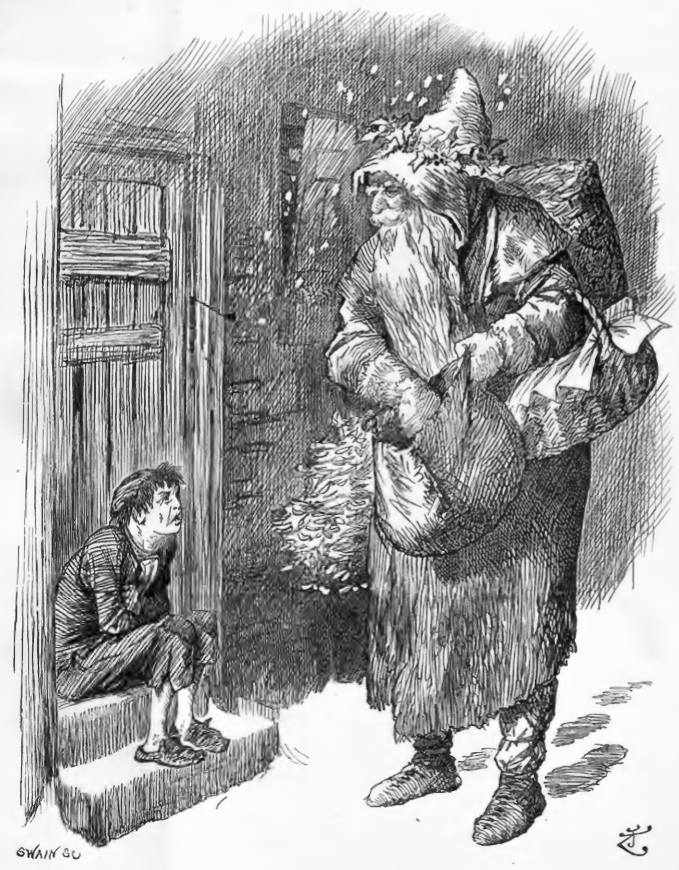
In 1841, the magazine Punch was established by Henry Mayhew with engravings by Ebenezer Landells. Punch was the first to coin the term "cartoon" as the name of funny drawings. The cartoons were mostly political or caricatures of important people. Alice in Wonderland illustrator John Tenniel worked as a political cartoonist for punch for over 50 years.


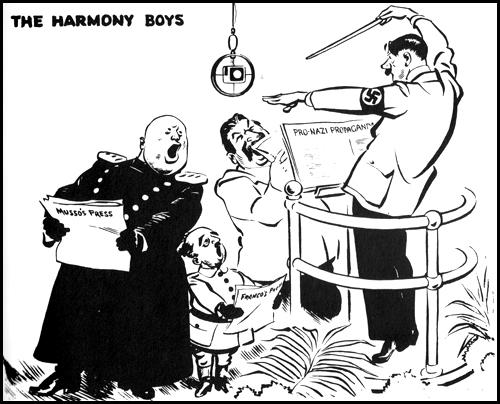
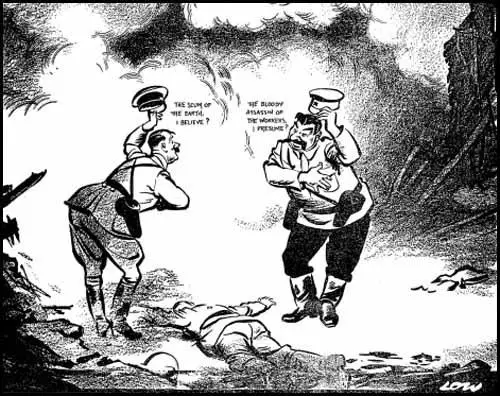
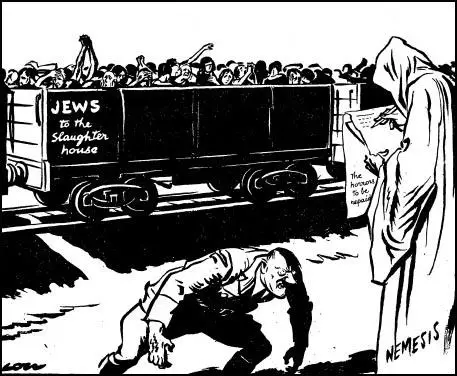
With the outbreak of the second world war, David Low created cartoons and caricatures that had strong political comments, with an ink brush technique. Low drew many cartoons depicting the fascist leaders at the time, such as Hitler, Stalin, and Mussolini, which lead to his work being banned in Nazi Germany and Italy. His most famous cartoons were featured in the newspaper the evening standard. The middle cartoon "rendezvous" is showing satire at the cynicism of Hitler and Stalin breaking their pact to not invade Poland. Lows cartoons had a lot of criticism from the conservative party, particularly of how he portrayed Neville Chamberlain and appeasement.
I checked out a book from Bower Ashton library called Man Bites Man: two decades of satiric art. In this book I found the art of Ralph Steadman. Unlike the cleaner black and white ink drawings and prints of Hogarth, Tenniel and Low, Steadmans' art style is more violent and chaotic, with blood colored paint splatters and scratches. He submitted caricatures and cartoons to Private Eye, and his work also focuses heavily on environmental issues such as whale and seal hunting. The environment is what I'm planning on doing my final piece on, and to look at his 1970s pieces and how different they are to the previous illustrations shows how quickly the art world was changing through the decades.


With the rise of technology in the mid to late 20th Century, it was more common for musicians to incorporate illustration into their music videos, but none have been as successful as the completely virtual band Gorillaz, created in 1998. The 4 band members are illustrated by Jamie Hewlett, who also helped create the album and magazine covers, press appearances, music videos, cartoon clips, live projected performances and an animated website. The music is created by ex Blur member Damon Albarn, and the two came up with the band as a satirical response to the mass production of similar boy-bands constantly shown on MTV. The cartoon band continues to develop and produce music that comment on important topics such as environmentalism and the state of the world.


To conclude, researching satirical editorial illustration has opened me up to new artists whilst further exploring the work of ones I already knew. The use of satire can make an illustration more humorous to the viewer, and I could use this research to potentially incorporate satire and environment together as a final piece idea.
Narrative characteristics in children's magazines:
After some more research into my article, I found that even though its from an adult satirical news website, the comedy of it and the drawings I'm doing are more catered to children. It's a nonsensical article about polar bears building rockets to escape the environment, and I want it to be bright and fun. To get a better idea of how editorial illustration can appeal to children, I've looked at the layout of some popular children's educational magazines to see how they visually communicate their ideas.
AQUILA:


These
different Aquila magazine articles are all very different, but have
colorful and captivating illustrations from different artists with lots
of detail It makes me realize how crazy you can go with the layout of
magazines. They all share a characteristic of having little blocks of
text accompany a large double page spread drawing allowing your eyes to
jump across the pages. This is easier for younger children than seeing a
big block of small print filling up a whole page, and if I incorporate
this method into my final piece, I will make the article more like a
story or comic, which children are more interested in.
ANORAK:


 Anorak is a children's magazine that aims to inspire and encourage
natural creativity and learn while having fun with stories, games and
activities. These travel stories are simple and colorful, with the
pictures being the main focal point over the text. It's a good way of
teaching kids about different countries and their food/culture. A lot of
the narrative in children's magazines is educational, as kids are
socially developing and are somewhat impressionable, magazines that
cater to their age group can help them grow up to be intelligent and
friendly.
Anorak is a children's magazine that aims to inspire and encourage
natural creativity and learn while having fun with stories, games and
activities. These travel stories are simple and colorful, with the
pictures being the main focal point over the text. It's a good way of
teaching kids about different countries and their food/culture. A lot of
the narrative in children's magazines is educational, as kids are
socially developing and are somewhat impressionable, magazines that
cater to their age group can help them grow up to be intelligent and
friendly.
OKIDO:

Another
important narrative characteristic in children's magazines, is that
there's usually the incorporation of characters that act as a guide for
the child to navigate the different topics of the magazine. I used to
read Aquila as a child, and each topic, Science, English, or History,
had its own character that would give you their own facts and opinions.
In Anorak, we follow the travels of the character O, and in Okido,
there's messy monster, who is curious to know how everything works.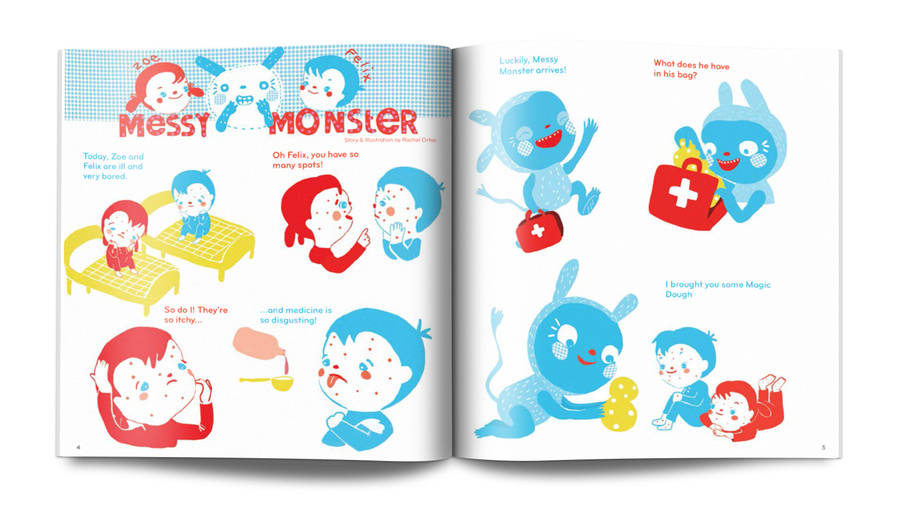

Comments
Post a Comment